Quantum Game
A puzzle game with real quantum mechanics. Guide photons through optical elements using superposition, entanglement, and interference.
About Quantum Game
Photons don't behave like billiard balls, and Quantum Game makes that viscerally clear. You place mirrors, beam splitters, and detectors on a grid, then fire a photon and watch it split, interfere with itself, and land — or not — exactly where quantum mechanics predicts. Each puzzle is a working optical circuit, not a metaphor.
The mechanics are grounded in real physics. Superposition means your photon can travel two paths at once; entanglement links particles so measuring one instantly determines the other; interference lets wave amplitudes cancel or reinforce. The game never dumbs these down, but it does let you see them in action before any equation appears. It sits naturally alongside other education games that teach through doing rather than telling. If you've ever bounced off a textbook explanation of quantum behavior, this approach cuts through faster.
It runs entirely in the browser with mouse-only controls, so no install or account is needed — open it, pick a puzzle, and you're placing elements within seconds.
Look inside
How to use
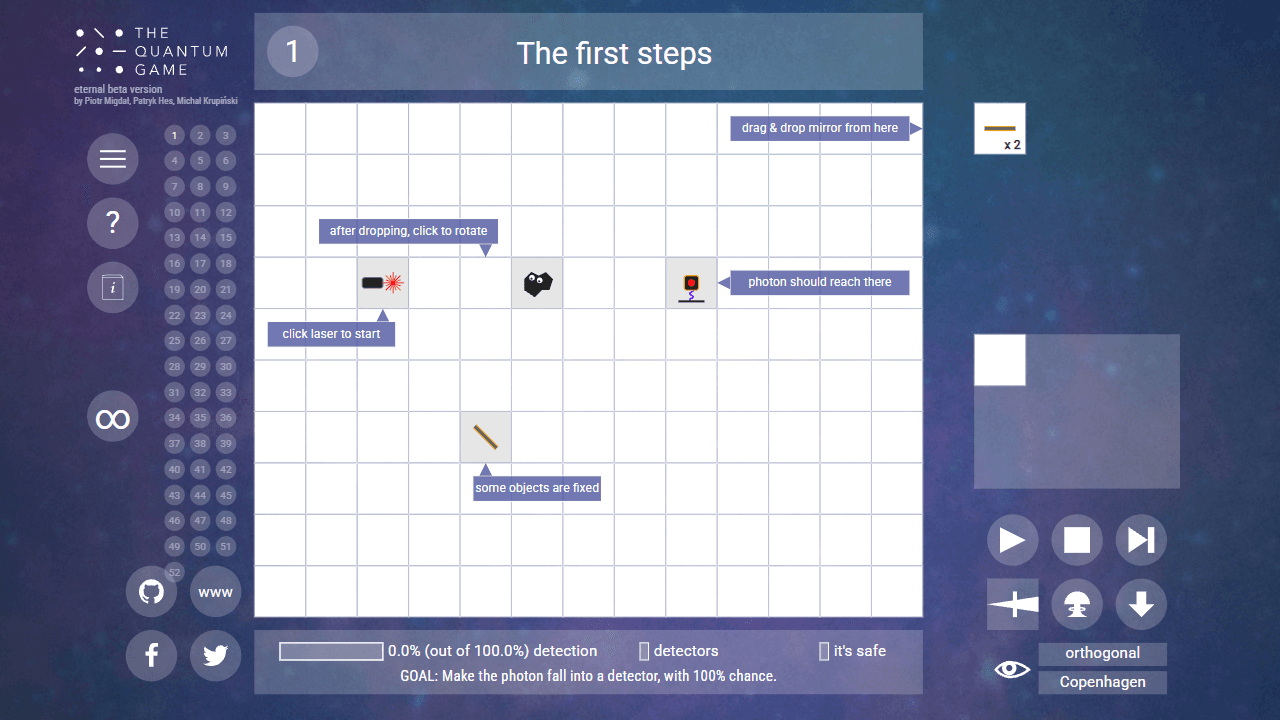
Your goal is to guide photons from sources to detectors by placing and rotating optical elements on the grid. • Click and drag elements from the toolbox on the right to place them on the game board • Click on placed elements to rotate them 45 degrees • Right-click on elements to remove them from the board • Press spacebar or click the play button to run the simulation and see photon paths • Press R to reset the current level Watch how photons behave with quantum mechanics - they can split, interfere, and change polarization when interacting with mirrors, beam splitters, polarizers, and wave plates. Some elements like detectors will absorb photons when hit. Complete each level by getting photons to reach all required detectors while avoiding mines (which end the level if hit). Pay attention to photon polarization and quantum effects like superposition. Use the level selector to choose different challenges, and check the encyclopedia to learn about each optical element's properties and behavior.
Reviews
No written reviews yet. Be the first!
More from Education
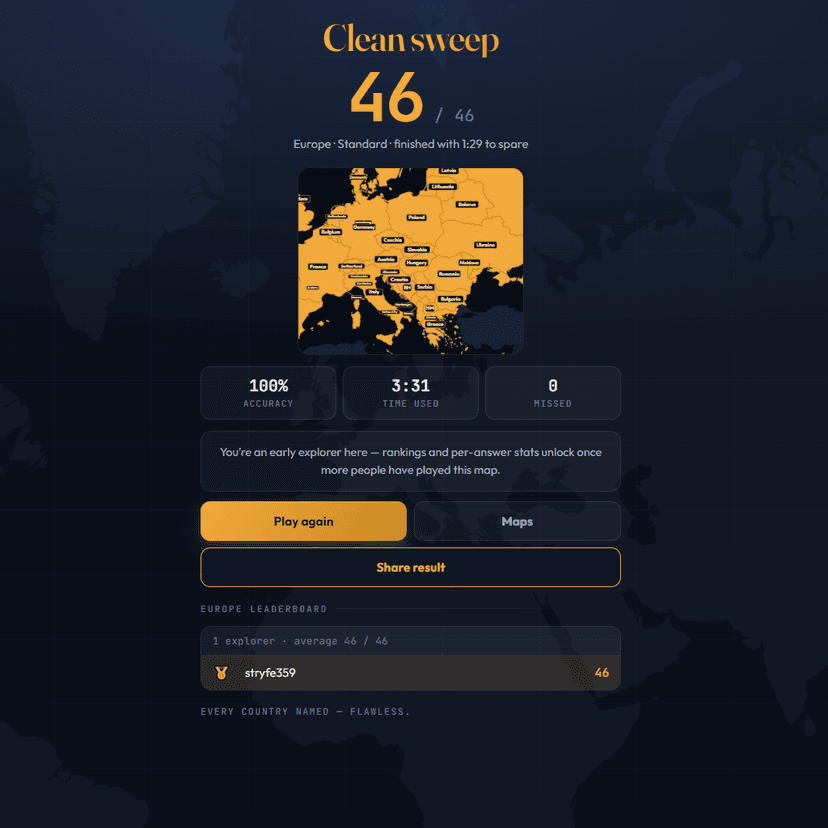
A geography speed-quiz. Type country names against the clock — every one you nail lights up the map. Eight maps (world + every continent), three paces, leaderboards, percentile standings, and a per-answer rarity stat that shows how many other players named each country.
by geodude