
Orbital Simulator
An interactive 2D orbital mechanics sandbox. Spawn objects around a central star and watch gravitational orbits, velocity vectors, and collisions.
About Orbital Simulator
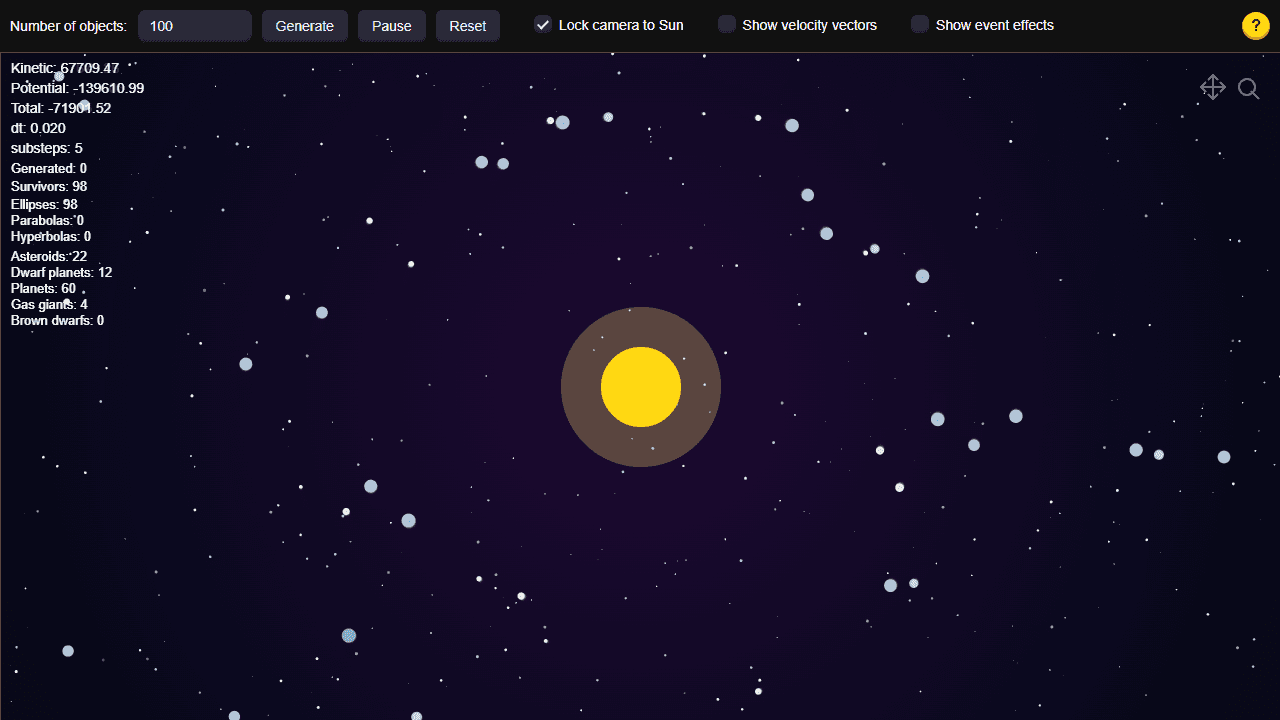
Spawn a planet, give it a nudge, and watch it arc into a stable ellipse — or spiral straight into the star. Orbital Simulator puts you in charge of a 2D solar system sandbox where you place objects, set their starting velocities, and let Newtonian gravity do the rest. Velocity vectors stretch and rotate in real time, collisions send debris scattering, and a single misplaced moon can destabilize an entire system in seconds.
It's genuinely useful for building intuition about why orbits work the way they do — why faster means higher, why two bodies tug on each other, why escape velocity isn't just a number. The physics is honest rather than hand-wavy. If you enjoy this kind of hands-on interactive simulation, Black Hole Simulator is a natural next stop for more gravitational chaos.
Controls are mouse-driven: click to place, drag to set velocity direction and magnitude. It runs best on a desktop browser where you can see the full vector overlays without crowding.
Look inside
How to use
• **Objective:** Create and observe realistic orbital systems around a central Sun using Newtonian physics • **Spawning Objects:** - Hold Shift + drag to launch a projectile in the drag direction - Use "Generate" button to create multiple random orbiting bodies - Adjust number of objects with the input field (1-500) • **Camera Controls:** - Drag (without Shift) to pan around when camera is unlocked - Mouse wheel to zoom in/out - Check "Lock camera to Sun" to keep Sun centered • **Information & Visuals:** - Hover over any body to see detailed info (mass, speed, orbit type) - Toggle "Show velocity vectors" to see movement directions - Toggle "Show event effects" for additional visual feedback • **Simulation Controls:** - Pause/resume the physics simulation - Reset to clear all objects except the Sun • **Physics:** Bodies follow realistic gravity, creating elliptical, parabolic, or hyperbolic orbits depending on velocity and distance from the Sun
Reviews
No written reviews yet. Be the first!
More from Interactive

An interactive particle sandbox. Drop sand, water, fire, and more and watch elements interact in a mesmerizing physics simulation.
by mohanad-80


