
Black Hole Simulator
Interactive 2D black hole with gravity, orbital motion, and accretion disk effects.
About Black Hole Simulator
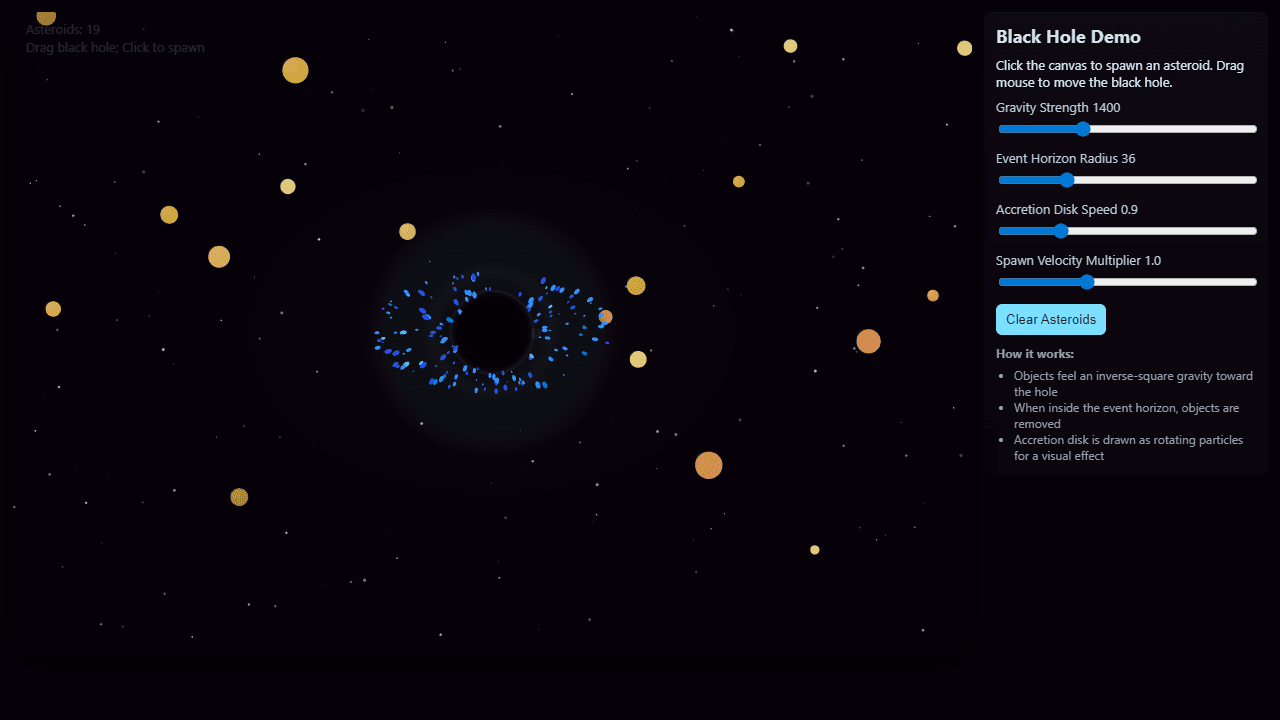
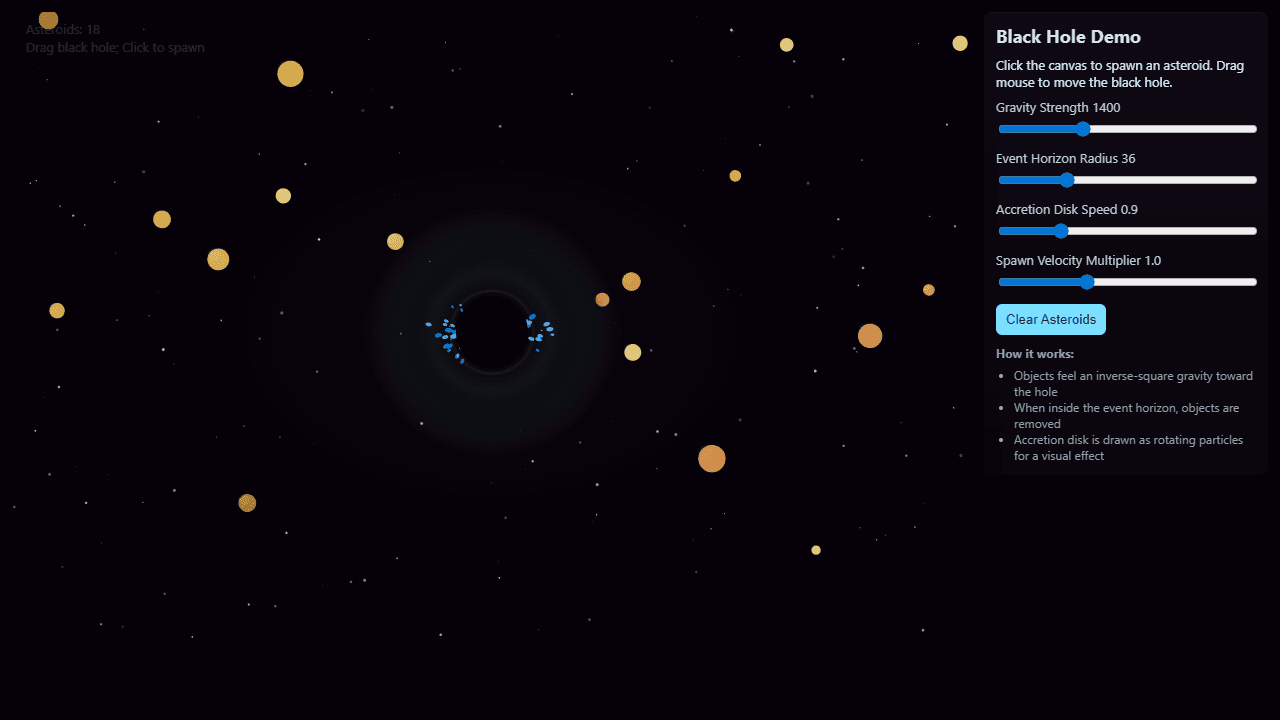
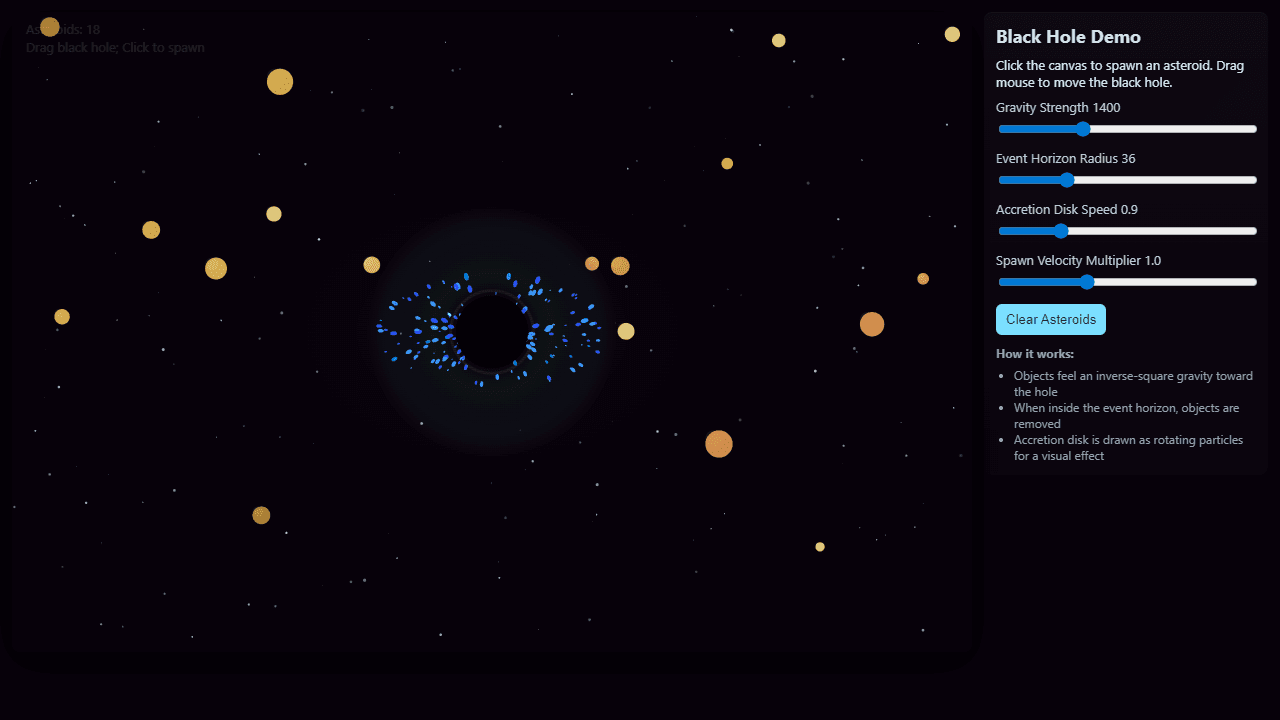
Click anywhere on the canvas and watch matter spiral inward, stretched and bent by a simulated gravitational singularity. Black Hole Simulator lets you place a black hole, then toss particles into its influence and observe how they orbit, slingshot, or get swallowed depending on their angle and velocity. The accretion disk builds up around the event horizon as captured material accumulates, giving you a visual sense of the physics without requiring a textbook.
It's a genuinely meditative thing to watch — a few particles become dozens, orbits stack on top of each other, and the whole system starts to feel alive. The simulation runs in real time, so small changes to where you click produce noticeably different trajectories. If you enjoy this kind of emergent, physics-driven play, interactive simulations on Launch Arcade have plenty more to explore.
Fluid Simulation goes in a different direction — fluid dynamics rather than gravity — but scratches a similar curiosity about how forces shape motion. Black Hole Simulator runs best on a larger screen because the full orbital paths need room to read clearly at a glance.
Look inside
How to use
Watch objects get pulled into a black hole with realistic gravity physics. **Objective:** Spawn asteroids and observe how they orbit or get consumed by the black hole's gravity. **Basic Controls:** • Click anywhere on the canvas to spawn an asteroid • Click and drag to move the black hole around • Use the "Clear Asteroids" button to remove all objects **Parameter Sliders:** • Gravity Strength - How powerfully the black hole attracts objects • Event Horizon Radius - Size of the point of no return • Accretion Disk Speed - How fast the visual disk rotates around the hole • Spawn Velocity Multiplier - Initial speed of new asteroids **Physics:** • Asteroids experience inverse-square gravitational attraction • Objects crossing the event horizon are consumed and disappear • Depending on spawn location and velocity, asteroids may orbit stably or spiral inward • The accretion disk provides visual feedback showing the black hole's rotation Experiment with different settings to create stable orbits or watch everything get devoured!
Reviews
No written reviews yet. Be the first!
More from Interactive

An interactive particle sandbox. Drop sand, water, fire, and more and watch elements interact in a mesmerizing physics simulation.
by mohanad-80


