
Flocking Boids
Watch emergent flocking behavior as hundreds of boids follow simple rules to create complex swarm patterns.
About Flocking Boids
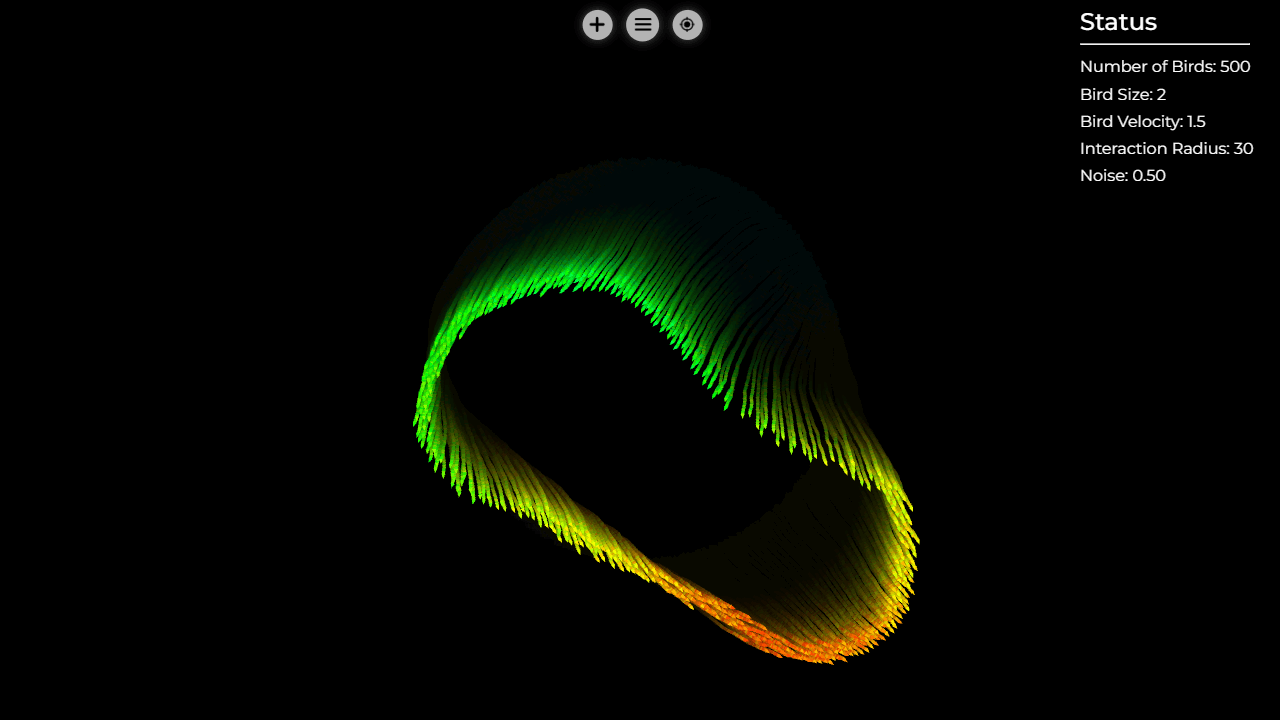
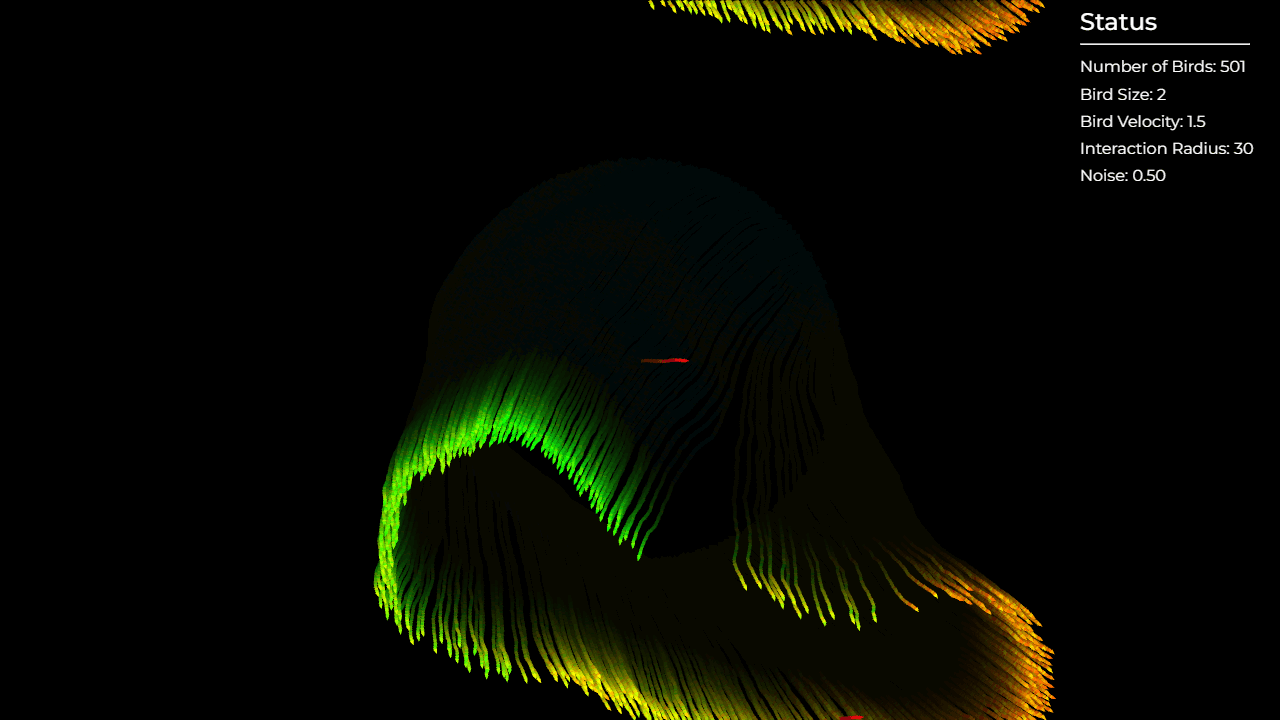
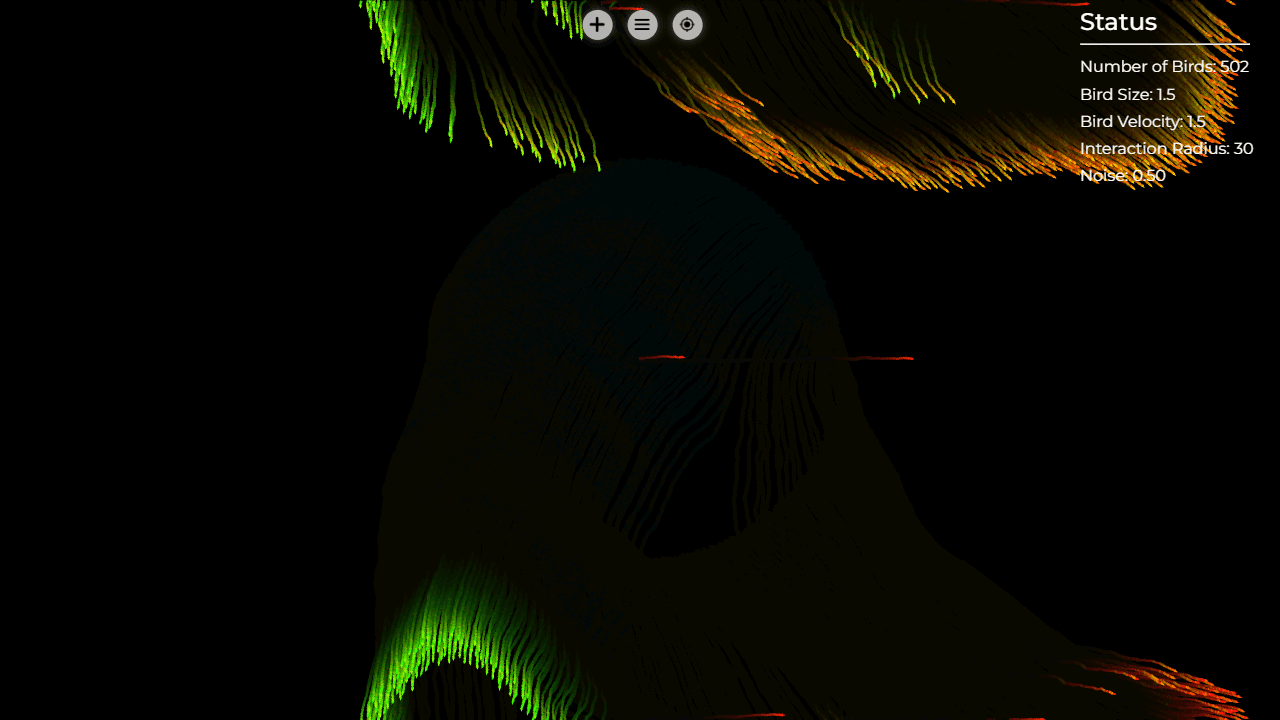
Hundreds of small agents — called boids — dart across the screen, each following just three rules: stay close to neighbors, avoid collisions, and match the group's direction. From those simple instructions, something genuinely surprising emerges: tight wheeling flocks that split around obstacles, rejoin, and ripple like a murmuration of starlings. No central controller coordinates any of it.
This is a classic of interactive simulation design, originally formalized by Craig Reynolds in 1986, and it holds up as a fascinating thing to just watch. You can also nudge the sliders — separation, alignment, cohesion — and immediately see how a small tweak collapses a graceful flock into a chaotic scatter or a tight, panicked cluster. If emergent group behavior interests you, Ant Colony shows a similar principle playing out through pheromone trails and pathfinding.
Works best on a larger screen where you can appreciate the full sweep of the swarm; the effect loses some of its drama on small phone displays.
Look inside
How to use
Watch bird-like particles (boids) move and flock together in this physics simulation. **Getting Started:** • Click anywhere to start the simulation • Observe how boids naturally form flocks by following their neighbors **Controls:** • **Mouse**: Move cursor to attract boids (if mouse following is enabled) • **P**: Pause/unpause simulation • **R**: Reset simulation • **A/D**: Add or remove boids • **+/-**: Speed up or slow down simulation • **Arrow keys**: Change boid size (up/down) or cycle through focused boids (left/right) • **J/K**: Decrease/increase interaction radius • **N/M**: Adjust noise (randomness in movement) • **F**: Focus on individual boid to see its stats • **I**: Toggle visibility of interaction radius • **S**: Save current frame as image **Customization:** • Click the menu icons (top-left) to open control panels • Adjust parameters like number of boids, speed, and interaction distance using sliders • Change spawn patterns, colors, trail effects, and wall behavior • Set boids to follow your mouse or ignore it The simulation demonstrates emergent flocking behavior - complex group patterns arising from simple individual rules.
Reviews
No written reviews yet. Be the first!
More from Interactive

An interactive particle sandbox. Drop sand, water, fire, and more and watch elements interact in a mesmerizing physics simulation.
by mohanad-80


