About Ear Training
Each round, you hear a chord or an interval and have to name it — that's the whole loop, and it's quietly addictive. Ear Training focuses on jazz harmony, so you'll encounter dominant sevenths, altered chords, and the kind of voice leading that trips up even experienced players. The interval recognition side builds the same skill from a different angle, training you to hear the distance between two pitches before your brain can second-guess itself.
It belongs squarely in music education, but it feels more like a reflex drill than a lesson. Short sessions work well — five minutes before a practice session is enough to sharpen your ears over time. If you also want to train a different kind of auditory recognition, Signal uses a similar listen-and-respond mechanic for Morse code.
No login, no account — just open it in a browser with your headphones on, because speaker quality genuinely affects how clearly you'll distinguish the finer chord colors.
How to use
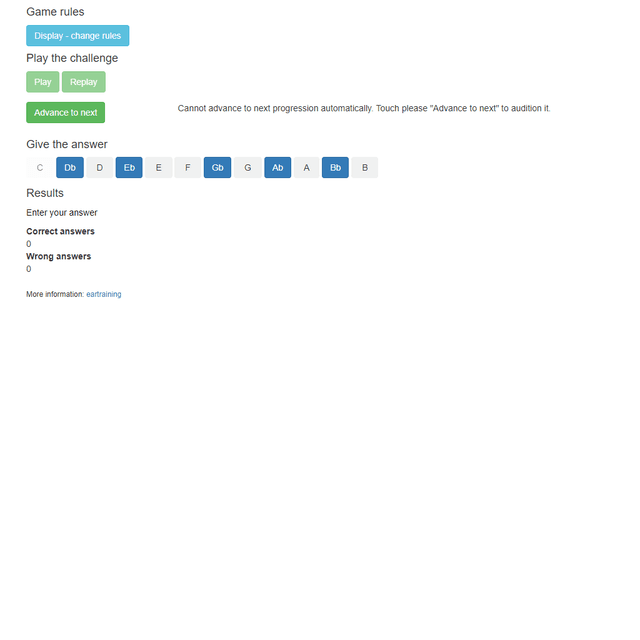
This app trains your ability to recognize jazz chord progressions by ear. Listen to piano recordings and identify whether they contain complete II-V-I progressions or stop before resolving. • Click "Play" to hear a random chord progression • Listen carefully to determine if the progression is "Complete" (full II-V-I) or "Unresolved" (stops at II-V) • Click your answer: "Complete" or "Unresolved" buttons • The app will show if you're correct and track your progress • Use the settings to choose between 3-note or 6-note voicings and different chord arrangements (A or B) • Click "Replay" to hear the same progression again • Your goal is to develop the ability to recognize these fundamental jazz progressions by sound alone The progressions cycle through all 12 keys. Complete progressions resolve to the I chord, while unresolved ones leave you hanging on the V chord, creating harmonic tension.
Reviews
No written reviews yet. Be the first!
More from Education

A geography speed-quiz. Type country names against the clock — every one you nail lights up the map. Eight maps (world + every continent), three paces, leaderboards, percentile standings, and a per-answer rarity stat that shows how many other players named each country.
by geodude


