3D Epicycles
Watch Fourier epicycles draw 3D shapes — cubes, spheres, dragons, and more — using the Discrete Fourier Transform rendered in Three.js.
About 3D Epicycles
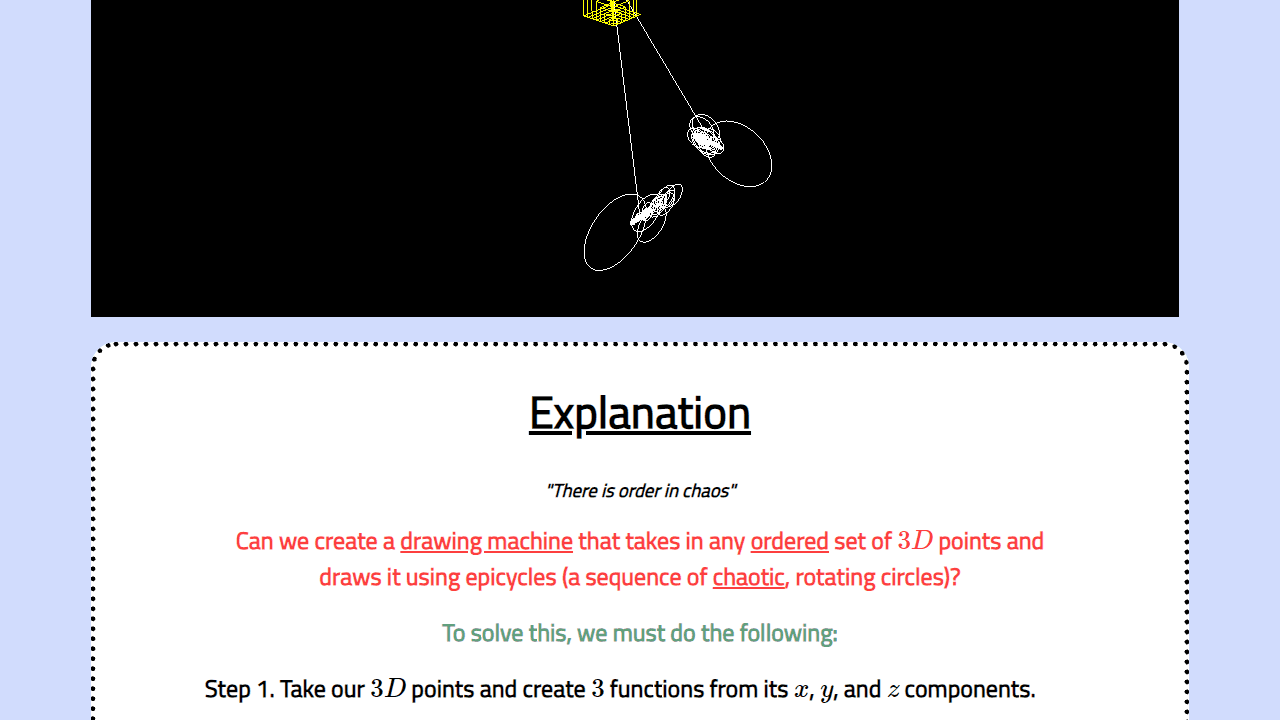
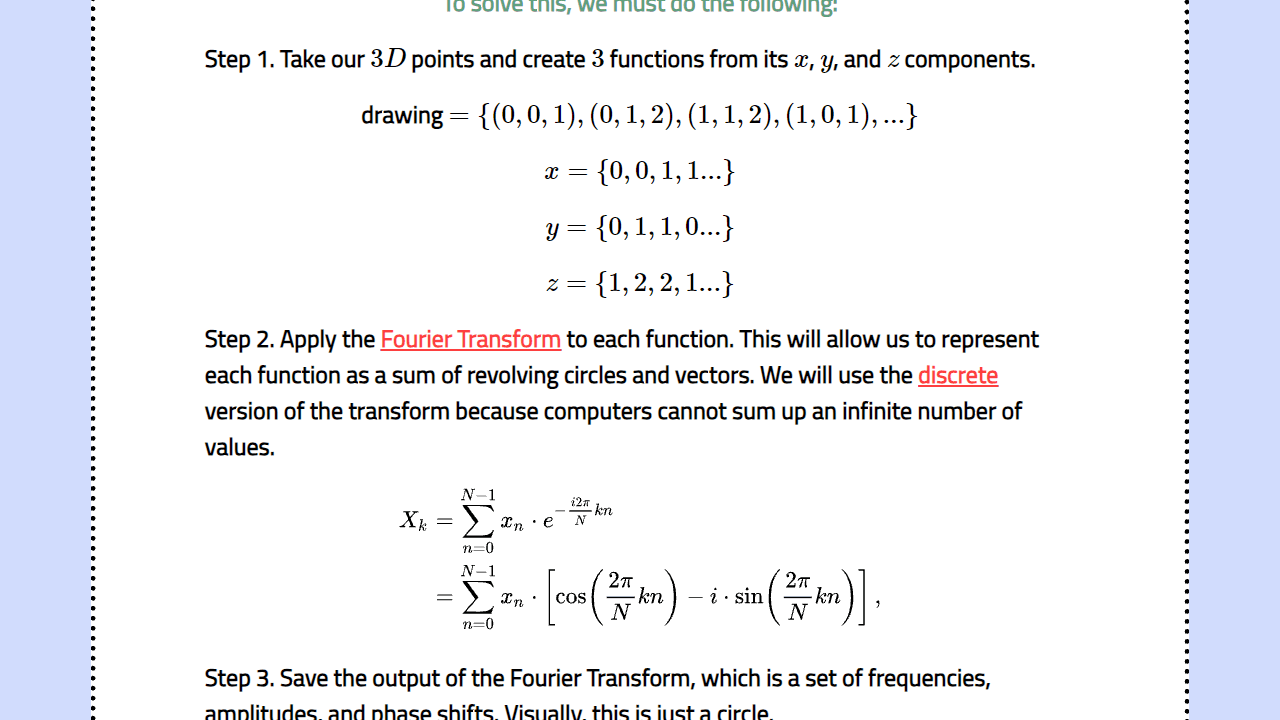
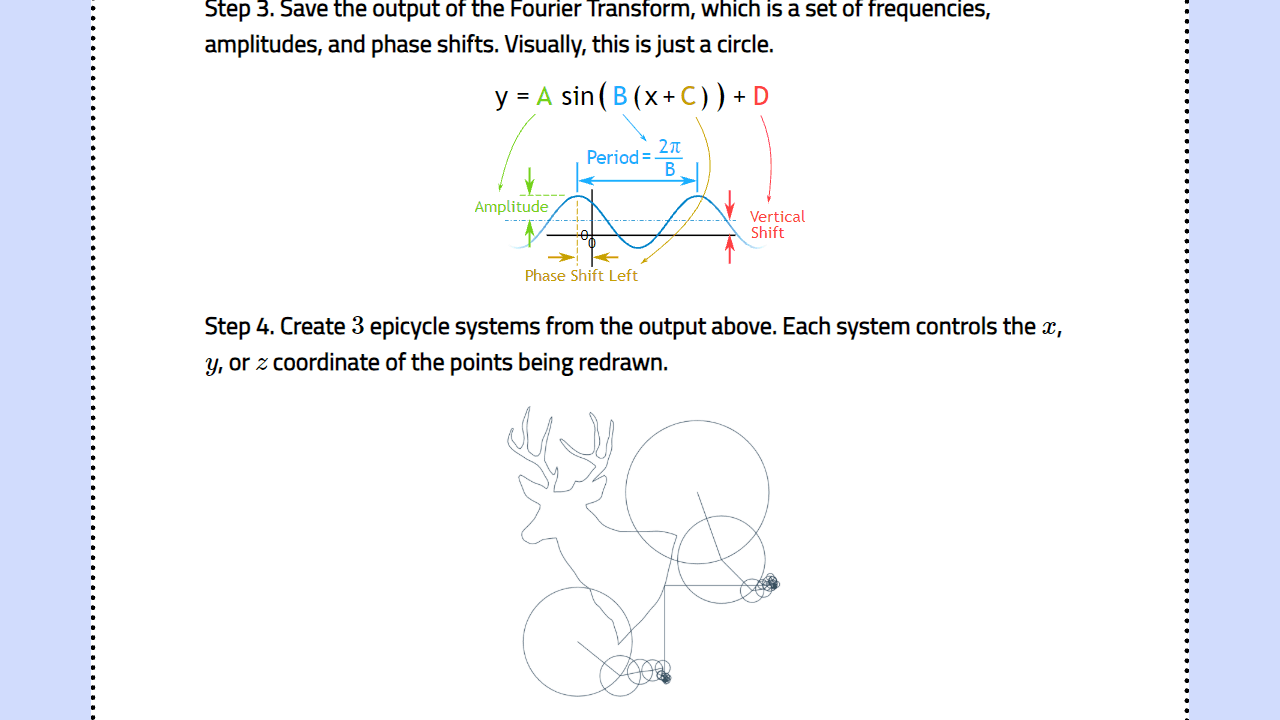
Pick a shape — a cube, a sphere, a dragon — and watch dozens of spinning circles build it from scratch. 3D Epicycles applies the Discrete Fourier Transform to decompose complex 3D paths into a cascade of rotating arms, each one offsetting the last, until the tip traces the original shape with surprising fidelity. It's the same mathematics behind signal processing and image compression, rendered live in Three.js so you can see every epicycle contributing its piece.
This is a visualization first and a lesson second. There's no quiz, no narration — just the geometry doing the explaining. Rotate the camera, slow the animation down, and watch how adding more frequency components tightens the approximation. It's a genuinely clear way to build intuition for why the Fourier Transform works. If you want to go further with interactive math tools, browse more education apps in the catalog.
Best experienced on a desktop or laptop where you can orbit the 3D scene freely with a mouse — touchscreen rotation works but feels cramped on small screens.
Look inside
How to use
This educational visualization demonstrates how 3D shapes can be drawn using rotating circles (epicycles) and the Fourier Transform. • Click any shape button to select a 3D object to draw • Watch as rotating circles combine to trace out the selected shape in real-time • Use mouse scroll wheel to zoom in and out of the 3D scene • Click and drag with mouse to rotate your view around the drawing • Use WASD keys to move your viewpoint through 3D space • Press R key to restart the current drawing animation The goal is to understand how complex 3D shapes can be mathematically decomposed into simple rotating motions. Each shape is recreated by combining many spinning circles of different sizes and speeds - this is the essence of the Fourier Transform applied to 3D drawing. Choose from simple shapes like cubes and spheres, or try complex objects like dragons and fish. The epicycles will automatically adjust to draw your selected shape, showing how mathematics can create order from apparent chaos.
Reviews
No written reviews yet. Be the first!
More from Education

A geography speed-quiz. Type country names against the clock — every one you nail lights up the map. Eight maps (world + every continent), three paces, leaderboards, percentile standings, and a per-answer rarity stat that shows how many other players named each country.
by geodude